I was sent full access to the TableTone app to review for my blog. While I am very grateful for the opportunity, I won’t let it sway my opinions. This will be my honest review.
Table of contents
What is Tabletone?
TableTone is a helpful tool for any Game Master looking to enhance the quality of their next campaign with a little bit a music, and a few immersive sound effects. TableTone is an app packed with carefully curated music and sounds that makes it easy for Game Masters to make their next adventure a little more epic. The app gives Game Masters access to over 400 unique sounds from epic battle music, mood setting ambiance, and everything in between. Sure you can tinker your own sound board and juggle around YouTube videos, but none of that will be as easy or streamlined as what TableTone has to offer. Go try Tabletone today!
Sounds
TableTone offers over 400 sounds from music to sound effects. Access includes:
Over 80 location themed sounds
30 ambiance sounds
and over 300 action, monster, and other sounds to add a little flavor to your world. (I am a huge fan of the dragon roar and weapon sounds)
Is it Free?
TableTone offers a trial with a few sounds for GMs to try for free. Once users are hooked, TableTone has a $9 subscription that grants access to the app’s growing library of sounds. With new sounds releasing each month, the subscription is an attractive way to test for the sounds you need in your next campaign. Note that the subscription will not be available for apple devices in the future. More importantly, users can out right buy the sounds they like and keep them forever. There is even a package to buy it all at a discounted price.
Review
I’ve tried running campaigns with music and even dabbled in creating my own sound board back when I was an overly ambitious DM, but found the process too distracting. It was something I slowly fazed out because it was too cumbersome and a little distracting. TableTone fixes this issue by giving me everything I need (and sounds I didn’t know I needed) in an easy to use package that I can take everywhere. If you are looking for a soundboard, or just some epic music for your fight scenes, TableTone is a powerful tool that should be at every one of your next campaigns.
Ease of Use
TableTone is the easiest way to run a soundboard or play music during your most pivotal story beats without distracting from the story telling. All you have to do is click through the library of sounds, and the app does the rest. Everything is categorized by worlds, settings, and even mood. There are even sliders that help customize the sounds, ambiance, and music to perfectly fit the tone of your campaign.
Quality
TableTone delivers high quality sounds at a press of a button. I went through as many of the sounds as I could, and while I found some awkward ones that I will never touch, the app had a lot of sounds that will be recurring. The app has a selection of good music, cool sounds, and the ambiance is well created. I really like the background tavern noise or the leaking sounds that echo in the darkness when exploring caves. The problem I have with using YouTube is that I have to do the research and find the high quality sounds to play for my campaign, but TableTone already does that for me. That means I have more time to plan the campaign.
Performance
I used the Windows app during my testing and it worked great. Everything was snappy and worked as intended. I was able to flip through TableTone’s sizable library with ease. Everything played as intended, and I didn’t hit any crashes during my tests. I had no issues running the app through my IOS device either.
Impact
I ran the most random session of D&D using TableTone because I wanted to test as many of the sounds as I could. I was not ready for much better a campaign could be by just adding a little bit of music. The App lets users customize the music by mood. Each location has a relaxed, suspense, and action setting. The first time I transitioned from relaxed to action for that first encounter is a high I will chase for the rest of my life. My players loved that shift and the music. It sort of made them murder hobos because they wanted to keep hearing the combat music, but I am not mad because it was a silly one shot and I got to test a lot more of the sounds.
My only complaint
TableTone is a fantastic app for running inperson games. You can play the music from your phone or your favorite Bluetooth speaker with minimal setup. Unfortunately, I only run online games. The issue was finding a way to use the app over Discord. My solution was to screenshare. I have two monitors. One monitor runs TableTone while the other ran my campaign. It worked very well. My players could hear the music, but they could also see the buttons. I believe they started making choices that would get me push certain buttons, but I think they were just tying to help me test as much as possible.
There is planned Foundry VTT support, and as someone who love Foundry, I am very excited!
Conclusion
I love TableTone, and found it to be a nifty little tool for running tabletop rpgs. It has a wide range of sounds to fit a number of locations and genres. Most importantly, it is very easy to use. I wouldn’t call it a mandatory tool, but it is nice to have when you want to add a little flavor to your campaign. I recommend starting with the trial. While limited, it does give users a proper taste of the apps functionality. I would then graduate into the subscription to test out TableTone’s library, and then slowly buying into packs you like. You can do everything this app does for free, but its nice to support the people who work hard to bring you these sounds.
Now GMs who have been running games for a long time will have their curated playlists, and won’t find the app as useful. This is meant for a the GM who doesn’t want the added task of finding the perfect sound or song, or the newer GM who is starting with nothing. Like I’ve said before, TableTone isn’t something you need to get, but it something that is nice to have when you need it. It is worth trying out once, but you might have trouble stopping after. Go check out TableTone today.
Free League Publishing has released a set of 20 high-quality figures to fill your next session of Alien TTRPG. The set comes with a condensed rulebook for skirmish play for players who want to enjoy some wargaming in the Alien universe. Most importantly, the miniatures are ready to fill your world whether you are following one of the prewritten adventures, like Rapture Protocol, or you are creating one of your own from one of the many high quality source books. Whether you leave them unpainted, or get a little creative with the paint, these are going to look great on any table.
What is Skirmish?
Skirmish is Alien TTRPG’s pvp mode. The game is designed for two players (or teams) as they fight for survival. Booklet includes three unique scenarios to help players get started, but there is room for some solid homebrew potential. For example, a team of humans must fight their way through a Xenomorph infested planet to retrieve keycards to help them escape. The game is over if the humans complete their objective, or the aliens kill all the humans. There are rules for army creation, combat, and even a fear mechanic to make the game very thematic. I am a huge fan of the radar mechanic because it makes the game flavorful. If you’re into Alien RPG for just combat, definitely look into the skirmish mechanics.
Thoughts on skirmish
I am not very good at wargaming, so I appreciate how easy this mode is to get into. I got destroyed the times I played, but I had a lot of fun doing so. The game mode is full of cool flavor that will make fans of the Alien series very happy. The fact that Xenomorphs start as blips of a radar until discovered is terrifying. The fact that one of them turns into a cat is fantastic.
Combat is strait forward, but engaging. I am not very good at army building, but there seems to be a good amount of options for some diversity. I am sure there might be a meta, but I had fun playing what was cool. I had a lot more fun playing the Xenomorphs, but only because I was better at it.
I love that the rulebook comes with the miniature because it makes the set a board game you can pull out when you are not running games.
Review
If you like the Alien movies, you might as well pick up this miniature set. This is a very cool set that will be a lot of fun to paint, even if you don’t end up playing the tabletop game.
Quality
I am amazed, but not surprised by how good the quality of these miniatures is. Free League Publishing consistantly produces high quality products for all their IPs, and it can be clearly seen in the amount of work that went into each sculpt. The Xenomorphs look terrifying, and the humans look like they are ready to survive the invasion. I had a lot of fun looking examining each figure and appreciating all the small features. The ripples of the muscles, the poses of the figures, and even face huggers look cool. I definitely wish I was good at painting.
Is it worth it?
Yes. If you are a fan of the series, the figures have the detail you need. Buy these, paint them, and add them to a cool scifi display.
You don’t need miniatures to run a campaign of Alien TTRPG. Before this set, I was just using coins, but it does make my players a lot more excited. The first time I pulled one of Xenomorps to attack the party is a memory I will treasure for ever. It is a very fun and useful accessory, if you have the space and need for it. I only bring these out for combat, so its nice that the set includes rules for a standalone game mode.
If you are buying this for skirmish, I think it is a fun little game mode that you can pull out when you don’t want to run a full session. Skirmish isn’t my thing, but I did have fun the times I played it. I’ll probably mostly use it for all my tabletop rpgs I run moving forward because of how good they look on the table. Now I just need to convince my wife to paint them for me.
I was sent a custom Elderwood Academy spellbook as a gift for the Riftbound launch. While I am very grateful for the opportunity, this will be my honest review of the spellbook. Make sure you check out the official Elderwood Academy page for unique tabletop RPG accesories.
Table of Contents
What is Elderwood Academy Spellbook?
Elderwood Academy Spellbook makes high quality TTRPG accessories. They make unique wooden dice trays, dice towers, and journals in the form of spellbooks. They offer hundreds of customization options so that you can get a book that not only fits your RPG needs, but fits your personality. If you are looking for a a clean and cool way to carry your tabletop accessories to your next campaign, check out what the Elderwood Academy has to offer. As a forever DM, I am a huge fan of their Master Tome DM Screen. It looks like a cool spell book and can carry everything I need to run my next campaign.
What I got
I didn’t get any of the Tabletop products to review, but I did get a special Riftbound Spellbook. As far as I know, it is a unique item that was created in collaboration with UVS, the people behind the Riftbound TCG.
The wooden box is lined with faux leather with the Riftbound, UVS, and League of Legends logo printed in shining text. My copy came personalized with my full name. The wood is smooth with a nice finish to give it that elegant flare, and the inside is decided to fit the four trial decks and booster packs snugly inside. The book closes securely with a magnet that is strong enough to keep your contents from falling out.
Review
The tome is very impressive. It is crafted from high quality materials with a good amount of care and attention. Unfortunately, isn’t very practical for my TCG needs. That said, I am impressed enough by the design and quality to look into the rest of their official line.
Quality
This spellbook was a very happy surprise. At first glance, it looks like a real book. The leather binding is very elegent, but the edges run a little long. I suspect they will wear down with travel and years of use, I can only hope they don’t start looking ratty instead of a used book. I’ve been carrying this around my bag and the edges don’t look as bad, and the wear seems pretty reasonable. Some of the letters are starting to crack which is normal, but the design is still visible. None of it has fallen off. It should survive a few years of normal wear and tear.
The wood bits are impressive. They have clean and clear designs and everything is smooth. Companies that cut corners will have pieces that start to crack or flake a the seems, but everything here looks well designed. All of the compartments are firm. Nothing felt loose or flimsy, even against my unrealistic force tests. Everything is staying in place.
The magnet that holds everything in place is very impressive. It is strong enough to keep your contents safely secured during travel, and can even survive a few hard shakes. I wouldn’t go flipping it upside down though.
The Fit
Elderwood Academy has an impressive attention to detail. The book is perfectly designed to fit its contents in a nice presentation. This book looks very cool with all four decks boxes snugly fit inside. The problem is, it only fits the four deck boxes and the unsleeved trial decks. It does not fit my entire sleeved deck, even if I remove the deckbox. The compartments are too short and anything taller than a 50 card single sleeved deck is spilling into the rest of the box. Your cards may not fall out because of the strong magnet, but you will need to do some reorganizing when it is time to take them out.
Taking them out is also a bit of a chore. The snug compartments are perfect to hold the deckbox, but it is a bit too tight for sleeved cards. I could take out most of the deck, but there was always a bottom portion that got left behind. I am afraid that using this tome as a regular deckbox will result in some damage to my cards.
To be fair, the book was not designed as an everyday deckbock. It was a giftbox to hold the trial decks, and it is perfect at that. If I didn’t sleeve the decks and kept them in the box, there are no issues. Unfortunately, I sleeve everything and the book can’t be used as anything more practical as decoration. This is a shame because I was very excited to take my cool looking deckbox to my next locals, and if they ever design one, they will take all of my money. It would be cool if they have a way to fit three decks and a slot for dice and accessories and even a notepad. They can even get a little extra and make their own deckboxes to fit the different compartments.
That said, if the quality of the specifications say anything about the brand, the Elderwood Academy TTRPG accessories are a guarantee banger.
Conclusion
Even though I am disappointed at the lack of practicality of my spell book, it is still a very cool gift that I will keep on display. I think the unique high quality feel makes up for the lack of utility, and it definitely makes me want to look into the rest of their line. I might even try to do a little modding of my won to repurpose it into a proper deckbox.
I was sent a few packs a couple of the Riftbound trial deck to review for my blog. While I am very grateful for the opportunity, I won’t let it sway my opinions. This will be my honest review. If you want to buy Riftbound, try to support your LGS. Don’t pay scalper prices. Anything above MSRP is not worth it. Usually I would post my TCG Plug, but the prices on there are too crazy. I don’t want to support the inflated market.
Table of Contents
What is Riftbound
Riftbound tries to bring the action-packed gameplay of the popular moba to the tabletop. Play as your favorite champion as you battle for supremacy in an unforgettable tabletop experience.
Winning
Players control a hero that gives them certain passives, but also dictates the colors and strategy of the deck. Each champion will have the colors that they can use in battle, and each color has a specific strategy they excel at. The goal of Riftbound is to score eight points before your opponent. You earn points by taking control of one of the two battlefields, except for the game winning point that requires control of both. You take control by moving units into a battlefield, and successfully taking or defending against an opponent’s units.
Resource System
What makes Riftbound unique is its resource system. Runes are a player’s primary resource system. These are a separate two color deck that the player pulls two cards each turn (3 on your first turn if going second). The player places these cards into a pool to cast spells, use abilities, and summon allies. Rune cards are kept in the pool unless the player recycles them. Some cards have an additional recycle cost. Players pay this cost by putting runes back into their resource deck (the card shows the cost). This creates Riftbounds interesting resource management mechanic. Do you play with less resources next turn to utilize a powerful ability?
Movement
Riftbound has a movement mechanic, but one that is simple enough to keep the TCG feel while still feeling meaningful. There are three locations a players can have units, in the base or one of the two battlefields. Battlefields are cards that have different abilities. Each player places one of their battlefield cards on the field at the start of the game, and switches the card at the start of the next game. Units enter a player’s base tapped, and can move into one of the two bases when they lose that summoning sickness.
How to Play
I am a visual learner, and the best tutorial I watched was by the Tolarian Community College. Definitely go find your favorite YouTuber in the space, but I like how clearly the professor lays out the mechanics and gameplay loop. It is very easy to follow and the visuals make it easy to understand. I don’t think I will be winning any tournaments soon, but at least I know how to play. Make sure you give the professor a like, comment, and subscribe. He’s earned it.
Review
Riftbound is a fun TCG with unique mechanics and interactions. Unfortunately, if you are looking for a new TCG to get into, you might need to wait till they fix the supply issue. This game isn’t worth the scalper prices.
Art
The unique art for the champions is fantastic. If you are a fan of the Moba, you will appreciate the love and care that has gone into each champion, especially the foil cards. Unfortunately, the rest of the set is rather unimpressive. While there are a few cute poros that got my attention, most of the cards didn’t leave much of an impression. Maybe I’ve been away from the game for too long and failed to appreciate the references, but as a collector, there wasn’t much to excite me.
It is the same issue I have with the publisher’s other game, Universus. Fun game, but only some of the cards are fun to collect.
I can’t really blame the game for its art direction. When a game takes on an established IP, there are limitations that prevent the creativity I’m looking for in a card game. The company has to do right by the established IP. This is kind of the double edged sword games like deal with. On one hand, the game pulls in the fans of IP that want a game, in this case League of Legends. On the other hand, they aren’t able to be as creative with the art. Unfortunately, this means most of the cards in Riftbound aren’t fun to collect. But does convertibility matter when the game is fun?
Gameplay
Riftbound is a lot of fun. The game is easy to learn, but it has a few mechanics that make it difficult (not impossible) to master. Riftbound has a solid mulligan system to prevent players bricking as often on the first turn. RNG can still make you brick on a mulligan, but it doesn’t feel as bad as a bad start in Magic or Pokemon. The mana system is great. It is a straight forward system that eliminates the flooding and screwing that happens in magic. Having resources exist as a seperate deck is awesome because I love drawing cards, but it means I need to have my deck sleeved in multiple colors. (Make sure you buy your sleeves where you play your games).
What I liked most about the game is the movement system. I’ve played a few TCGs with movement mechanics, like Genesis Battle of Champions and Paragon, but none of those feature a grid based system that felt more like a board game. I loved my time with both those games, but I am not very good at strategically moving units across a battle field. Not to mention, movement can bog down the game. In Riftbound, movement is simple (just three spaces) but it felt meaningful. Most importantly, I didn’t feel overwhelmed by the number of choices.
Unfortunately, while the game may be fun, the quality isn’t quite there. At least on the first printing.
Quality
The more packs of Riftbound I opened, the more disappointed I became with the game as a collector. The card stock feels thin and like it can be easily damaged. All of my packs came damaged from the factory. All of my cards, including the foils, were already whitening around the edges. This is extremely disappointing as a collector, but something I would be willing to overlook because the game is fun.
I am glad I got my packs for free, and I am very glad they didn’t send me better quality cards because I would be very upset if I paid above MSRP. I am willing to support the game in the hopes that future sets and cards get better print quality, but I wouldn’t rush to pay the scalpers to play this game. It is a fun game, but I want my cardboard to be a little fancier.
Conclusion
Riftbound is a refreshing TCG that deserves a lot of the attention it has been getting. It has interesting and fun interactions, but the first set is a rough launch. In its current state, I can’t recommend it, but mostly because players can’t get their hands on reasonably priced product. If the supply issue improves and players are able to enter the competitive scene without having to sell their soul. Especially since the quality makes the first set not much fun to open. If this issue gets resolved, I’m willing to change my review because I had a lot of fun with Riftbound. I say proxy until you can find product at MSRP.
I was sent a free copy of the Doomlings expansion, Castle Glass. While I am very grateful for the opportunity, I won’t let it sway my opinions. This will be my honest review. Make sure you also check out my review for the Doomlings Base Game and the Shadow Puppets expansion. I’ll be using my Amazon Affiliate link where possible. It really helps me out if you use it before you buy anything.
Table of Contents
What’s in the Box?
30 x New Traits
7 x New Dominant Traits
2 x New Ages
1 x New Catastrophe
1 x Mystery Foil
What is Castle Glass?
Castle Glass is Doomlings‘ ocean themed expansion. It features vibrant sea themed cards for a fun and colorful upgrade to your Doomlings deck. You will need the base game to play with these cards.
Castle Glass introduces three trait classes to the game: Shells, Coral, and Fish. With these new classes comes the trait system, an additional way to rack up points. If you collect two or more of the same class, you get a class score bonus. The class bonus are as follows:
Regular Shells, Fish & Corals are each worth +1
Curious Shells, Fish & Corals are each worth +2
Exotic Shells, Fish & Corals are each worth +3
This means that if at the end of the game you have 2 shells, one exotic and one regular, you get an additional four points added to your total.
Review
I love Doomlings. It is easily one of my favorite board games, and will bring it out often at my table. Castle Glass is a fantastic addition to my collection, but I do have a couple reservations.
Art
I love the fun and vibrant oceanic theme in Castle Glass. Despite the simple design, Doomling cards always have a lot of flavor and whimsy. The fish are cute and they very creative with their shell and coral designs. Castle Glass has the prettiest Ages cards I’ve seen so far. I love the scene of the sand castles at sun rise/sun set.
Gameplay
I believe Castle Glass adds interesting mechanics to the game. I had a lot of fun with the fish cards. Fish cards had abilities that let you play multiple cards a turn, letting players build their school of fish quickly. You can use fish to cheat out other cards in your hand, draw for better cards, or get that trait bonus at the end. It was very flavorful. Coral cards seem to add some disruption. It would have players discard cards, or it would let you get bonuses for cards in your opponents gene pools. Shells lets players peak at the next age, which is very valuable information if used correctly.
The only issue I see with this expansion is that it adds a new scoring mechanic to the end game tracking. It is not a hard mechanic to track, but some people aren’t going to like having to count the number of shells and worry about the types. Honestly, I don’t think it will complicate the game too much, depending on your deck size. If you have a massive Doomlings deck and cards aren’t clustered, it will add a couple of points, but nothing that will get out of hand. I played with a small deck to make sure they came out more frequently, and it never felt like scoring got out of hand. Even if you don’t like the extra math, the mechanics in this set are worth it.
Conclusion
The Doomlings base game is perfect, and if you are trying to get into this game, start there. Now if you’re looking for expansions to spice up your deck, Castle Glass is solid. It has a fun oceanic theme with some interesting mechanics to shake up the meta. Whether or not you should buy this expansion really comes down to if you are willing to do the extra math at the end. I don’t see it as a huge problem, but I also see hot it takes away from the casual vibe the draws people to the base game. I will say I do prefer the Shadow Puppets expansion a little more, but I won’t be taking Castle Glass out of my massive Doomlings deck any time soon.
The folks behind Doomlings sent me the Shadow Puppets Bolster Expansion for free to review for my blog. While I am very grateful for the opportunity, I won’t let it sway my opinion. This will be my honest review. Make sure you check out my review for the base game. I’ll also be using my Amazon Affiliate link where possible. It really helps me if you use it before you buy anything.
Table of Contents
Box Opening
What’s in the Box?
Shadow Puppets Bolster expansion is a 40 card expansion that introduces four new species of Doomlings: Deeplings, Glitterings, Moonlings, and Fuzelings. The breakdown:
Doomlings is a quirky little card game about the end of the world. Players take turns building a strong gene pool from cards they pull from a collective deck. Each card has a value and some have abilities that interact with other cards or players. For example, a card can allow a player to draw more cards each round, giving them a slight advantage. Each round has its unique set of rules based on the age or catastrophe card in play. For example, a card can force players to only play a certain color card. The game ends when four catastrophe cards are played and the winner is the player with the most points.
How to play
Games with Denver James has a fantastic tutorial that you should watch before you get started. Make sure you give him a like and a follow.
What is Shadow Puppets
Shadow Puppets is a darker themed expansion that essentially allows players to play trap cards. It allows players to disrupt a players turn, swap cards, and even give away cards. It also introduces the subvert mechanic which allows players to sacrifice Doomlings for points. What makes Shadow Puppets unique is is dark edgy flavor of both the abilities and artwork. The set does have a few demonic looking Doomlings. This is your trigger warning.
Review
The Shadow Puppets expansion brings some surprisingly needed dark humor, with interesting mechanics that only make the game more fun. If you like the flavor of the set and need some more trap cards, go get yourself a copy.
Quality
Doomlings is a high quality card game with some very good looking game pieces. The Shadow Puppets Bolster expansion is no exception. The cards are a little thinner than I am used to, but the art and quality of the card stock is as excellent as ever. I still recommend using sleeves. I may be a crazy person that sleeves everything, but it really makes shuffling the cards easier. You will be shuffling this game a lot, and the sleeves will help preserve the game.
Mechanics
I absolutely love the mechanics for this set. Nor only is each new species flavorful, the interactions it creates are so much fun. I love the fact that at any moment, you can just disrupt a persons turn or strait up ruin their whole strategy. There is a card that lets that lets you swap gene pools. You can build a bad pool on purpose to swap with someone who is actively trying to win and ruin their day. It’s like the blue shell in Mario, but with more control. Of course, someone can just swap hands with you and ruin your strategy. That feels pretty balanced to me.
I really like the ages in this expansion. One lets you draw 3 and discard 2. This creates some very tough choices, but it is always fun to draw cards. The other mechanic lets you swap hands, and this can absolutely ruin someone’s day. If you want a set with a lot of disruption, Shadow Puppets is fantastic.
Conclusion
I love Doomlings and recommend to anyone who wants a fun and simple game to pull out at game night. The game is easy to teach, especially for people new to the hobby, and the game is family friendly. Most importantly, it is very easy to set up and take down. Games of Doomlings are pretty quick, but the interactions make it meaningful.
Now if you’re looking for an expansion, Shadow Puppets is awesome. The disruptive nature of the expansion gives the game a layer of fun I didn’t think it needed. It has definitely earned its spot with the rest of my collection.
Free League Publishing sent me a free copy of the Mutant: Year Zerocore rulebook to review for my blog. While I am very happy for the opportunity, I won’t let it sway my opinions. Make sure you also check out my reviews for Dragonbane and The One Ring.
Table of Contents
What is Mutant: Year Zero?
Mutant is a tabletop roleplaying game about mutants at the end of the world. The game runs on the award winning Year Zero system which is a D6 system where things happen on 6s and 1s. Six is good and one is bad. There are no modifiers. Instead, stats and gear tell players how many dice they need to roll. More dice generally means better odds. Finally, Mutant is a survival game where the world is harsh, people have powers, and starvation is always a bad roll away.
Hook
Before the fall of civilization, Earth existed in a constant state of conflict. War broke out across the globe, quickly turning nuclear. Those smart and rich enough quickly found shelter in secure underground bunkers while others fled into the safety of space. Everyone else either died in the first wave, or had to rot away in the fallout. As the Earth became toxic, many began to mutate and develop powers.This was the next stage of evolution of man, but one that also marked its end. Mutants are sterile, and while there are tales of powerful folk that roam the wasteland, the population is aging towards is final days.
Some survivors band together and form flourishing communities known as arcs in an attempt to recapture what they lost, others turned to the harsh wasteland and let it transform. You were fortunate enough to grow in one of these arcs, and spend your days working towards a common goal. As the years go by, resources start to dwindle and the world becomes a harder place to live. Eventually, you and a promising group are tasked with going out farther than the usual patrol in search of anything that will extend your time on this planet. What secrets will you uncover beyond those walls? What will you bring back? Can humanity ever be saved, or are you merely surviving till your final days?
Gameplay
Mutant is a very easy game to pick up, but has enough depth to keep players engaged. The survival mechanics give players agency, without ever feeling like a chore. The mutation mechanic adds fun flavor that players can explore through their character, and it makes for some fun and interersting interactions. If you’ve ever wanted to be Xmen at the end of the world, pick up Mutant Year Zero.
Resources
Resources at the end of the world are limited. Players will need to spend their time constantly hunting for food, water, and other materials to survive the harsh dying world around them. Resources like food and water are expended every day for survival, but they are also used for healing. Rationing this precious resource keeps a high level of tension for the players. Players can choose to be at full health for the next encounter at the risk of starving to death. The system is streamlined so the bulk of the game is focused on the game rather than resource management, but you can make it more hard core if that is fun for you.
In Mutant, bullets are the most valuable resource after food and water. While players don’t need bullets to survive the wasteland, they are useful currency when it comes time to trade for better gear or materials. Bullets are also used for guns, and no one wants to be short a bullet in an important gunfight. Players will constantly need to weigh the benefits of trading away their bullets, and that will make for some difficult decisions.
Rot
The world rots away under the effects of the lingering radiation. While there are a few clean and hospitable areas left on this planet, there are pockets of deadly radiation spread in between. These areas give players rot points that slowly kill them. The only way to get rid of rot is to rest in a clean area, but those may be far in between during an adventure. The best bet is to avoid rot all together, or find some rot protection over time. Unfortunately, sometimes the only way forward is through a puddle of rot, and sometimes the only drinkable water is contaminated. The problem then becomes finding ways to mitigate the rot, and live with it.
Mutations
You can’t have a Mutant’s game without cool mutant powers, and this book has a very good selection of them. The DM can allow players to choose their mutation or roll for them at a table. I prefer rolling because that randomness gives the game its flavor. Survivors in this world wouldn’t have been able to choose their powers, neither should your players. That said, I’ll let a player choose their mutation if they have a fun idea that won’t kill the fun for anyone else.
As you would expect, mutations give players abilities they can use in and out of combat. Every player gets a mutation point per mutation at the start of each session that rolls over to the next if not used. Mutation points are the resource used to power the mutation. Because mutations are so powerful, this limit is used to balance the game. If the player could use their mutation as much as they wanted, things could get out of hand. Mutations can also backfire. They can explode or work as intended. They can also further mutate the user, leaving them weaker but with a cool new power to use.
Combat
Combat does not get any simpler than in Mutants. Attacks succeed on 6s and fail on 1s. Additional 6s give the user extra boons like bonus damage or the ability to disarm. Additional 1s can mean the weapon breaks, leaving its user defenseless. Weapon and gear do break in this game, and players will need a skilled craftsman for repairs, or enough bullets to buy the replacement.
What makes combat deep is the health and cover system. The way health works means that players will need to think carefully before rushing in. They may not have the resources to heal back, or they can get an injury that affects their performance. Learning how to effectively use the environment in combat is extremely important. Effectively finding cover in a gun fight or exploding a barrel can easily mean the difference between life and death.
Leveling
I love the leveling system in Mutant because it is streamlined and accessible. Players will need to answer the following questions:
Did you participate in the session? (You get 1 XP just for being present.)
Did you perform a Day’s Work for a project in the Ark?
Did you explore at least one new sector in the Zone?
Did you sacrifice or risk something for your PC buddy?
Did you sacrifice or risk something for the NPC you want to keep safe?
Did you sacrifice or risk something to mess with the NPC you hate?
Did you sacrifice or risk something to reach your big dream?
Players get 1xp point per yes, and they level up when they earn a total of five. Leveling means players will get put a point into a skill of their choice or pick up a new talent. This system not only eliminates the guess work you would see in something like D&D, and it allows players to customize their character. Personally, it forced my players to act in ways they wouldn’t normally because they wanted an XP point. Where in a D&D campaign they wouldn’t care if the NPC died, they went out of their way to keep them alive and get to know them. I was not ready to RP as much as I have in Mutant, but I am not complaining.
Other Mechanics
There are other very cool mechanics that make this game unique and fun to play, but I don’t want this post to get too long. I pulled out the most notable that set it apart from other systems I’ve played, but also the systems I’ve liked the most. While I do not currently run a hardcore survival campaign, its nice to play something more bleak and I’ve been enjoying the story that has come from it.
Review
Mutant Year Zero is easily one of my favorite TTRPGs. I love how accessible the game is. It is easy to learn, and this is important for table of busy dads. Mutant also has some fantastic flavor with the mechanics that make for a good story.
Quality
I did get a copy of the physical book, and it is beautiful. The printing is high quality with vibrant colors, and the book is very high quality. I love the comic book style art. It gives the game its distinct personality and the book looks fantastic on my table.
The cover is phenomenal. I love how it draws the attention to the survivors combing a burning crumbling city for danger and supplies. Their nonchalant expressions suggest that they’ve grown used to the wreckage, and remain unfazed by the apocalypse. The worn mismatched outfits fit the flavor of the world, and the colors tie it all together. I love that each character has a hint of their ability showing. It is just enough to make a statement about their power, while still evoking curiosity. Are these good guys? Bad guys? You’re going to have to play and decide.
Story
The corebook has a prewritten adventure, and it is a very good place to start if you’re a beginner or just need a little help. The adventure offers a solid mystery with an interesting hook to get things rolling.
The players start at the arc, with an aging leader and dwindling supplies. They are sent out in search of more, but find hints to the fabled Eden. Eden is a place of abundance, populated by the most brilliant minds to find a cure for mutation. Some say the cure exists somewhere within its walls, the trouble is finding it. Others say its all a cruel joke told by those too dumb to realize it is all over. As fate has it, your players find themselves chasing a legend, and what they find isn’t what they expected.
Adventure
What I like most about how the adventure is written is that it gives players to tell their own story around the main goal. The adventure outlines a meta story, fills it with important NPCs and location, and sprinkles enough clues to create agency. The gamemaster players have the freedom to do what they want. I’ve never had my players more invested in the world building, because we were building our world. We had a session where we just talked about the fake mutant animals that existed in the one zone and creating bits of random lore that carried throughout the campaign. I love that I was not tied down by a dungeon crawl because it allowed us to tell some very cool stories.
Most importantly, I love that my players liked the meta story enough to keep playing through it. I’ve ran modules where I stopped using the source material because my players wanted to do something different within that world. I wasn’t ready for them to start asking questions about Eden and actively working towards it because of how much time we spend messing around in character.
Roleplay
This is one of the games where my players got into unique characters. I think the random mutation forced them to play a character they wouldn’t usually which was very cool to see. It might also help that I ran this game with theater of the mind using Alchemy RPG. The official module for Mutant is fantastic. Maybe the lack of math and battle maps gave players the room to get creative with their roleplay. Whatever the answer, it was a lot of fun.
Theater of the Mind
You can get as fancy as you want with Mutant. You can use maps with intricate terrain and figures, or load up your favorite VTT and do it digitally. Run this game in whatever way is most fun for your table. The system will work no matter what. At my table, we run games through theater of the mind. I’ll use maps here and there, but I like the focus to be the story and the current format works for us.
As a theater of mind game, Mutant is a fantastic system. The year one system makes checks and combat easy to manage, and the mechanics give enough depth without needing much outside aid. If all you have is the rulebook, some dice, and a dream, you are ready to run Mutant Year One.
Survival
Do not be intimidated by the survival aspect of this game. Run this game as hardcore as it needs to be for your table. I run a casual table and would frequently forget to manage resources. There wasn’t enough scarcity, and I didn’t deduct enough resources. I did break weapons and give players rot points, but I wasn’t running the game as intended. That said, the game never felt like it lost any of the survival element. Players were still cautious with their decisions, and scavenging when they could. My campaign, as silly as it was, was still a survival campaign. I like that freedom.
Conclusion
If you want to run a survival campaign with cool mutant characters and have a good amount of freedom to tell a cool story, pick up your copy of Mutant Year Zero. This has become our favorite, and it is going to be hard to switch to anything else. You can pick up your copy of the Mutant Year Zero rule book on the official Free League Publishing website, or on DriveThru rpg if you want to go digital.
Enclave is a unique narrative-driven TTRPG that doesn’t use dice. Players play through one-shot style adventures assigned to them by the Enclave, and facilitated by their Conduit. Longer campaigns are possible with this system, but it the design is for one-shots. This gives players and Conduits a freedom to always try something new and different, or grow throughout the myriad of missions that come their way.
Enclave first edition includes six unique classes, with six new classes being introduced in the game’s first expansion. A successful campaign could mean even more classes to explore. With an almost unlimited amount of builds and an expansive world to explore, there is always something to do in the world of Manifold, and you don’t even have to roll to get into it.
The Flavor
You are a mercenary hired by The Enclave to deal with whatever issue, big or small, that arises in the expansive world of Manifold. The Enclave is a massive secret organization that deals with worlds problems, provided there is something to profit. The Enclave does not only seek gold, but information, favors, and anything else there is to gain in this world. This gives them the freedom to set off any type of adventure, and the nearly infinite resources to make them work. The world of Manifold is a massive multiverse of possibilities, only limited the a tables imagination. Whether you are embarking on the one of the books included adventures, joining one on the official discord, or creating your own, a fantastic story awaits. You just have to make it up.
Gameplay
The Loop
Players are briefed on their mission in where they are given all the information they need to be successful. They are then teleported to the missions location where they must use their skills and creativity to complete the mission’s objectives. Players will then roleplay and describe what they do to complete the mission, and it is up to the conduit to make things happen. Unlike other systems, there is no random chance to shape the narrative. In Enclave, the story is written by how well the players roleplay their character. This doesn’t mean that the player has to be good at acting or using voices, but those who can create a tangible character and get creative with their actions are rewarded.
While Enclave gives a table the freedom of limitless adventure, there are limits to keep things somewhat grounded. Actions need to be plausible, with the appropriate stats to back them up. A Conduit can always tell players no, if there is reason to. There may not be critical failures baked into this system, but players can fail their actions. Actions have consequences. A player can set off an alert, or get caught in a lie that loses the party a valuable lead. Most importantly, players can die. There is a system in place for players to leave a mission at any time, but the chance of death is always present, and death is permanent.
Whether a mission ends in success or failure, there is always a new adventure for the next session.
Liveplay
Games like these are always better to learn by watching. The Old Warlock have a great video I recommend you watch. It s a good resource if you want to learn how to play the game or run the game. I found it very helpful when I was researching for my first run of the game. Make sure you give them a like and subscribe.
The Review
Enclave is a fantastic RPG that deserves more attention. If you play TTRPGs for the story, there is no better system. The game is easy to learn, easier to teach, and quick to setup. I found it to be a fantastic change of pace that I didn’t know we needed.
The Table
At my table, we are a group of busy dads who try to get together every Wednesday to catch up and play roleplaying games. My party will play anything I ask them to, but I can’t be too complicated. They barely remember what happened last session. The group is made up of three people, exluding myself. There is one person who is always ready to roleplay, one who meta games and plays optimally, and one who casually shows up for the comradery. Each one has their unique take on every game we play, and its been fun to see how they adjust to each new system. I was not ready for what Enclave had in store for us.
What it had in store
This was the fastest onboarding I’ve had of any game. My players usually struggle with the rules at the beginning. The first session is usually spent on looking up rules. We got right into the thick of things with Enclave, and my players enjoyed the freedom. The more we played the game, the more invested they became. I don’t think I’ve had a game where they remembered everything from the previous session, or be as invested in the world building as they were with the system. Your mileage will vary. We have been together five years and have a level of comfort that made the game fun.
The Session
I ran two missions, and each mission took 2 days each. I ran The Tragedy of House Gaulegvok mission included in the book, and I made up heist. The system is open to any genre and setting, with the only limit being the Conduit’s imagination.
From the Book
The prewritten adventure is a fantastic place to start if you are new to the game (after watching the video or joining a game on the official Discord channel). Players are hired by their patron to look into the villige’s mysterious disappearances. The book gives Conduits key points, NPCS, and a few ideas for encounters, but doesn’t railroad. This gave us the freedom to shape our story, and I loved it. Our games tend to be sillier, and the darker setting was a nice change of pace. It was also a perfect way to start October. If you need ideas, running The Tragedy of House Gaulegvok is a great place to start.
From the Dome
Once I got the hang of things, I was ready to create my own mission. The prep was very easy. I came up with the scenario, jotted down some plausible threats and details, and created the NPCs the players would interact with. This was the easiest game to prep for because I didn’t need to spend time balancing encounters or looking for maps, but the freedom the system gives you was a little intimidating. In most systems, I have that crutch of a dice roll, but here it would be all me. This time I couldn’t insert some random stat to buy some time, but it didn’t matter. Either because I’ve been doing this long enough, or i just naturally vibe with the system, I found Enclave easy and enjoyable to run. I was worried for nothing.
The Game
The game does get some getting used to if you’re coming from a system with a table. How do you as a conduit decide what happens? How hard do I need to make things? For me, as long as it was cool and plausible, I let it happen. Is it the right way of doing things? We had fun, so I’d argue yes. But every table is different, and the game does have an advanced ruleset to adjust the gameplay if needed.
I was a little worried going into this game because Enclave needs everyone to participate in the story telling. I was surprised to see my players start getting into character. It was nice to see my players do something because it was what their character would do and not the correct thing to do.
With games like Dungeons and Dragons, I found that my players were always worried about solving the encounter with numbers. Stats become more important than the exploration. While I did enjoy our time with D&D, I did not enjoy being bogged down by all that math. Enclave was the first time I saw my players try something different, but I will definitely need to run more games to get them to be weird.
The Art
The game includes art by the very talented Greg Taylor, and I will be including it throughout the article. I am a huge fan of the unique flavor and style, and find it fitting. I also like the collection of fan art that creator proudly displays throughout the server. If you want to help a game grow and make a tangible impact, make sure you join the Discord.
The classes
Enclave has fun and unique classes. I love the amount of flavor that goes into each class ability, and how they break away from the traditional style of class you see in other systems. For example, the Librarian class has an ability where they can come up with a piece of lore or information by making it up on the spot. They have to say it out loud in character, and if it makes sense, it becomes true. Not only is this an ability you would expect from a Librarian, but it gives players an incentive to get into character and help shape the world. There are a lot of other builds and flavors to choose from, and the one-shot style missions allows players to try them all.
Type of Game
Enclave doesn’t have an explicit setting or genre. The Conduit has the flexibility to create whatever world and adventure they want, in what ever genre they want. Horror, western, high fantasy, the game can be adjusted for any type of campaign and any kind of adventure you can think of, and that is a very good start to adventure. Best of all, the one-shot style type missions make it so you can always try something new. What makes Enclave unique is that a session doesn’t always need to be a mission and experience doesn’t need to come from a session.
Conduits can run casual events like parties where players come in character to roleplay without any mission objectives. Despite that, players can earn an item, ability, or something unique to help them on their future missions. I didn’t get to run this type of session, but I can see the value it has on world building. Players can also earn useful perks outside of the game by creating art or music, or having private in-character conversations with each other (so long as there is a witness). It is a very cool way to get players to not only get invested in the world, but get to the build it as well.
What I enjoyed most
I loved that there was no dice rolling. As much as I love the massive collection of dice I’ve accumulated over the years, it was nice to not be bogged down with all the rolling. We do a bit of theater of the mind already, and it was nicer to not have to deal with as many technical issues. Instead, we could focus on the story.
Creating the story was a lot of fun. There was a bit of awkwardness in the beginning as we got comfortable with the system, but narrative eventually started flowing. I found it helpful to ask follow-up questions about an action to get players to describe, or throwing a random NPC to spark some roleplay in the beginning. It didn’t take long to get into character. I enjoyed watching my players work through problems in character and getting invested in the world. Enclave is easily my favorite game to run because of the freedom it gave us to sit down and tell a story, even if it was a ridiculous one.
The Problem
The lack of dice can be a problem. Players need to be comfortable with roleplaying and improvisation because without player agency, there is no story. As a Conduit, you will need to do some heavy lifting in the beginning (especially with newer players) to get the table comfortable enough to roleplay. But I would argue this is true in any system you try. I would argue that not having a session bogged down by dice rolls definitely had its benefits.
The Community
If you are curious about the game but don’t have the friends to play with, Enclave has an active growing community on their official Discord. They run regular games, including non-mission ones, and enough knowledgeable people to answer any questions. The Discord is also a great place to keep up with any news or updates about the game.
What do I think?
Enclave is a fantastic system that deserves more attention, but it is not fit for every table. Everyone has their reason for playing ttrpgs, and some players won’t vibe with system. There is nothing wrong with that. Some players just want to roll dice and feel like they are winning encounters and that is a very valid way to play a TTRPG, so long as everyone is enjoying it. For everyone else, Enclave is a fantastic ttrpg experience. Enclave is easy to learn, teach and set up. If you want to sit down with your friends and create a fun story and have a good time, there is no better system than Enclave.
The Kickstarter
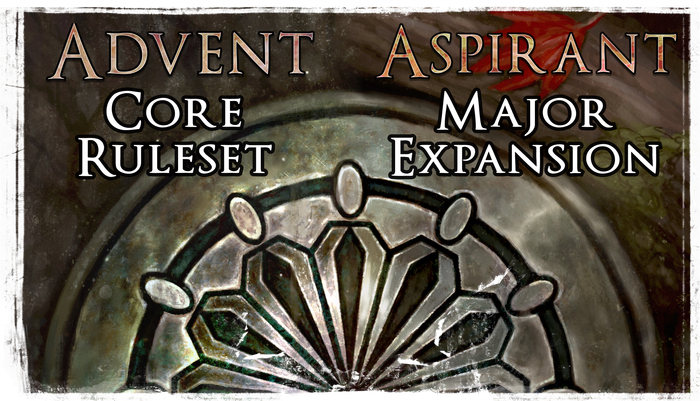
If you’ve made it this far, the best place to start is with the Kickstarter. The game will get its 2nd Edition and first expansion. I am sure players wouldn’t mind using the older rules, but the game has had two years to mature, and the updates The Kickstarter for Enclave Advent 2nd Edition and the game’s first expansion Aspirent should be live by the time you read this review. Make sure you go support and follow.
Paizo sent me a free copy of the Starfinder 2e: Galaxy Guide to review for my blog. While I am very grateful for the opportunity, I won’t let it sway my opinion. This will be my honest review. Always support your LGS if they carry Starfinder, but you can grab your copy of the guide on Amazon through my afilliate link. Make sure you also check out my newest sponsor, NordVPN.
What is the Galaxy Guide?
The universe is an endless space of adventure, mystery, and treasure. The Galaxy is shaken by the awakening of the newborn. Some flock to its side with zealot hunger. Others take to space to profit off its ever reaching effects. Gather your crew, load your ships, and find your adventure amongst the stars. What kind of stories will you find?
The Galaxy Guideis a helpful resource for the Game Master that needs a bit of inspiration for their next pathfinder campaign. The guide gives GMs ideas for running different genre’s of space themed adventures. I personally love the ideas for a horror themed adventure, but there is a good mix of ideas that can adapt to any table. The Guide is a good place to find planets, cities, factions, and other world building tools to fill your Galaxy. On the player side, the guide introduces new archetypes, backgrounds, and ancestress for some fun and fresh new characters. It might not be mandatory, but it is a nice resource to have when needed.
What do I think?
The Galaxy Guide is a very good looking book. I am always impressed with the high quality of the Paizo resource books, and the Galaxy Guide is no exception. The illustrations are colorful, vibrant, and inspiring. I loved looking at the different races, planets, and ships. The guide includes a galaxy map for a bit of added immersion.
As far as lore goes, the book is so much fun to read. It is a little bare, but I think the point is to inspire and guide rather than be the definitive source of an adventure. Remember, you can always make things up, but it is always nice to have some lore at the ready. Especially when you have inquisitive players who are hungry for lore. The different locations are neat, and I got some cool ideas for my own adventure. Looking forward to running a horror-themed, escape from a prison planet campaign. As far as player content goes, I saw a few cool ideas for character’s I’d love to run, if I ever get to play.
As far as resources go, the Galaxy Guide is an optional luxury. While the book has some cool flavor and ideas, it isn’t needed to run a good campaign. All you need is the core rulebook, some dice, and your vivid imagination. That said, this is a very cool book to have, even if you only end up reading through it. I loved reading the different bits of lore and flavor, but I definitely wish there were more. As someone who can get too busy for any proper planning, it is nice to have lore I can easily sprinkle when needed.
Maestro sent me the2001: A Space Odyssey board game for free to review for my blog. While I am very grateful for the opportunity, I won’t let it sway my opinions. Always support your LGS when buying board games, but you can pick it up from Amazon through my Affiliate link if you want to help me out. You can also check out my newest sponsor NordVPN if you’re looking for a good one and want to help me out.
What is 2001: A Space Odyssey – The Board Game?
This is a one vs many game based off the iconic book (or movie) of the same name. It is a 3-5 player game that takes about 30 mins to play through and rated for ages 10 and up. It is available now on the official Maestro Media store.
Players split off into two groups: the players who play as H.A.L and the crew who tries to stop H.A.L. This is a card game where players go back and forth, playing cards to either blow up the ship or shut down H.A.L. H.A.L can shut down systems, target players to slow their progress, or close doors to slow their movement. H.A.L can also listen to everyone on board the ship, so players will need to be clever with what they say to each other or risk getting caught by H.A.L.
The players on the other hand must move through the ship using their cards to undo the damage H.A.L. has done. They each have special abilities and can trade with one another, but H.A.L.’s ever pretense makes it difficult to work together.
H.A.L. wins if it is able to shut down the three systems or life support. The players win if they are able to shut down H.A.L.
Review
Before you get discouraged, you don’t need to know anything about the book or the movie to enjoy the game. People who have might enjoy the flavor and catch some solid reference to the source material, but it isn’t mandatory for understanding the game. In fact, this is one of the easiest games to teach and learn. Most of the time, I need a video because that is how I learn, but the rulebook is easy to read and the game play loop isn’t too complicated. This is a great game to pull out for people who don’t play many board games because onboarding is so easy.
The game itself is beautiful. The pieces are well printed on high quality cardboard. The game pips are bright, colorful, and with a good amount of detail. The cards are a little thin, but they are high quality prints that are easy to read. I sleeved my cards because I am a crazy person who sleeves everything, but you can get away with not sleeving them if this isn’t your go to game. The box has a beautiful thematic design with enough space for sleeved decks and the remaining game pieces. I love this box and it will be one that I keep on display.
Now the H.A.L. screen is flimsy and will fall. I wish it was made with cardboard, but I also understand keeping the cost down. It isn’t a huge deal if you’re only pulling the game out once in a while, but you will probably need to create your own if you pull this out every day. This isn’t a huge deal breaker, but it can be annoying if you have fix it every so often.
The gameboard is beautiful. The print is vibrant and the words are clear and legible. The board is a little thin, and I advise caution when opening it. I ripped mine a bit because I wasn’t paying attention to the direction of the opening. This is not the company or the boards fault, I was just a little too excited and didn’t open it correctly.
Most importantly however, the game is fun. Maestro does a good at creating the appropriate ammount of tension through the game’s mechanics. For the crewmembers, having that limited movement coupled with the limited resources as you race across the station trying to shut down H.A.L. is hard. Having to do it with a team but not being able to talk to them without giving too much away makes things tricky. Finding ways to communicate and work together makes it fun though. For H.A.L., having multiple crew memebers working against your goals is frustrating. It is frustrating to watch crew members undo your hard work, but it is so much fun figuring out what your players are up to, and shutting them down.
One thing I will say, RNG can scew a game, so make sure you shuffle well. Either side having a stacked deck because the cards weren’t shuffled properly can ruin a game. I recommend picking up some cheap sleeves for easier shuffling.
If you’re looking for a cool scifi game, or need a break form your favorite TTRPG, 2001: A Space Odyssey is a great place to start. It is a good looking game with fun and easy to learn mechanics. It is great for beginners, even those unfamiliar with source material.